Irish Address Validation API Playbook: Using Eircodes, Authoritative Data, and Scalable Data Pipelines
As organisations increasingly rely on data‑driven systems, address data quality becomes a critical dependency. In Ireland, free‑text addresses are often ambiguous, inconsistent, and difficult to validate at scale, particularly in rural areas or complex urban developments.
This is where Eircode’s and API‑driven address validation play a central role. This guide outlines how to validate, enrich, and operationalise Irish address data using APIs and modern data pipelines.
To validate Irish addresses at scale:
standardise input → match against authoritative data → verify or append the Eircode → enrich with geocodes → persist results with confidence metadata.
Using Eircode’s as a property‑level identifier dramatically improves address accuracy, deduplication, and spatial analytics across systems.
Why Irish address data is hard to manage
Irish address data presents a unique set of challenges for modern data systems. Unlike countries with long‑established, area‑based postcode hierarchies, Ireland’s addressing landscape evolved organically, resulting in high variability and ambiguity in how addresses are recorded and interpreted.
Key challenges include:
- Many addresses are non‑unique without an Eircode
- Rural addresses may lack street names or building numbers
- Locality and townland names are reused across counties
- User‑entered addresses vary widely in spelling and format
- Multi‑occupancy buildings introduce sub‑address complexity
Without systematic address validation and enrichment, these challenges quickly propagate across data platforms and operational systems, leading to:
- Duplicate records
- Failed deliveries or service visits
- Poor geospatial accuracy
- Unreliable analytics and reporting
Eircode as a property‑level data key
An Eircode uniquely identifies a single property in Ireland. When verified, it can act as the strongest available location identifier for Irish address data.
From a data perspective, a verified Eircode enables:
- Deterministic record linking across systems
- Improved deduplication and master data management
- Reliable property‑level geocoding
- Consistent joins between operational and analytical datasets
Best practice: treat free‑text addresses as probabilistic and verified Eircode’s as deterministic identifiers.
What address validation means in API terms
In technical implementations, address validation is not a single operation. It is a pipeline of related processes, typically exposed through one or more APIs, that progressively transform raw, user‑entered address data into a verified, enriched, and analytics‑ready record.
Each of the following stages play a distinct role in improving data quality and reducing ambiguity.
- Standardisation – clean and structure raw input
- Verification – confirm the address exists
- Eircode validation or append – verify or supply the correct Eircode
- Confidence scoring – quantify match quality
- Geocoding – assign coordinates with known precision
A well‑designed API response should return not just a “fixed” address, but metadata explaining how and why it was matched. At a minimum, this includes:
- Match status and confidence score
- Reason codes explaining the outcome
- Whether the Eircode was verified or appended
- Geocode precision and source
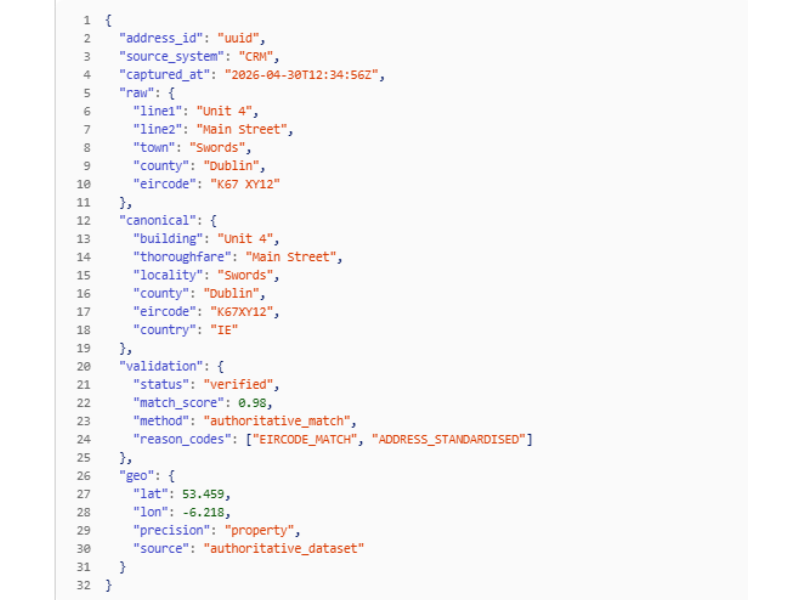
Recommended canonical address data model
To support governance, auditability, and analytics, address data should be stored in a way that preserves both the original user input and the validated, canonical result.
In practice, this means separating what was captured from what was resolved. Raw address data reflects how an address was originally entered; often incomplete, inconsistently formatted, or ambiguous. The canonical address represents the standardised, verified version produced by the validation process, typically enriched with a confirmed Eircode and geospatial coordinates.
A well‑designed canonical address model therefore becomes more than a storage structure. It acts as a control point for address data quality, enabling consistent behaviour across operational systems, data platforms, and analytical workflows.
Example canonical schema (simplified)
Address validation decision flow (Ireland‑specific)
A practical ruleset for Irish address data:
-
If an Eircode is present
Verify Eircode ↔ address match
Flag conflicts rather than overwriting silently -
If no Eircode is present
Match address text
Append verified Eircode where confidence is high -
If the address is partial or ambiguous
Enrich missing components
Return match confidence and alternatives if required -
Once validated
Geocode to property‑level precision
Persist canonical results
API integration patterns
1. Point‑of‑entry validation (real time)
Used in:
- Web forms
- CRM and case‑management systems
- Customer or citizen onboarding
Benefits
- Prevents poor‑quality data entering systems
- Improves user experience with address suggestions
- Reduces downstream remediation costs
Technical notes
- Synchronous API calls
- Timeouts and graceful fallback
- Capture match confidence and corrections
2. Batch cleansing and enrichment
Used for:
- Existing customer or asset databases
- Data migrations
- Periodic data quality improvements
Benefits
- Cleans historical data
- Appends missing Eircode’s and geocodes
- Aligns datasets to a common standard
Technical notes
- Idempotent jobs
- Partition by update date or source
- Persist exceptions for manual review
3. Event‑driven validation
Used in:
- Streaming architectures
- High‑volume transactional systems
Benefits
- Decouples validation from core systems
- Scales efficiently
- Enables near real‑time data quality
Match confidence and exception handling
Not all matches should be treated equally.
A common threshold model:
- ≥ 0.95 → auto‑accept
- 0.85–0.95 → accept with flag
- < 0.85 → route to exception handling
Always store:
- Match score
- Reason codes
- Source of validation
This enables explainability, auditability, and continuous improvement.
Common Irish address edge cases
Data teams should explicitly handle:
- Townland‑only addresses
- Duplicate locality names across counties
- Apartment and unit parsing
- Legacy “care of” address lines
- County abbreviation inconsistencies
- Eircode formatting variants (e.g. spacing)
Authoritative datasets are critical for resolving these consistently.
Monitoring and governance
For production systems, track:
- Validation success rate
- Eircode conflict rate
- Average match confidence
- API latency and error rates
- Cost per validated record
From a governance perspective:
- Retain raw input for audit
- Log all automated corrections
- Define overwrite rules clearly
- Restrict access to enriched datasets where required
Why authoritative Irish address data matters
The quality of validation and geocoding depends entirely on the underlying data source. For Ireland, authoritative datasets provide:
- Complete national address coverage
- Verified Eircode‑to‑property links
- High‑precision geocodes
- Consistent classifications
This is especially important for rural, newly built, or complex addresses.
Learn more about GeoDirectory’s API services
If you are building or scaling address validation pipelines for Ireland, GeoDirectory’s API services support real‑time validation, batch cleansing, Eircode verification, and accurate geocoding using authoritative Irish address data.
Explore how GeoDirectory’s APIs can help you improve address data quality, reduce ambiguity, and support reliable analytics and operations at scale.
Want to learn more about Irish Addresses ?
Read Our Address Validation Blog Series